
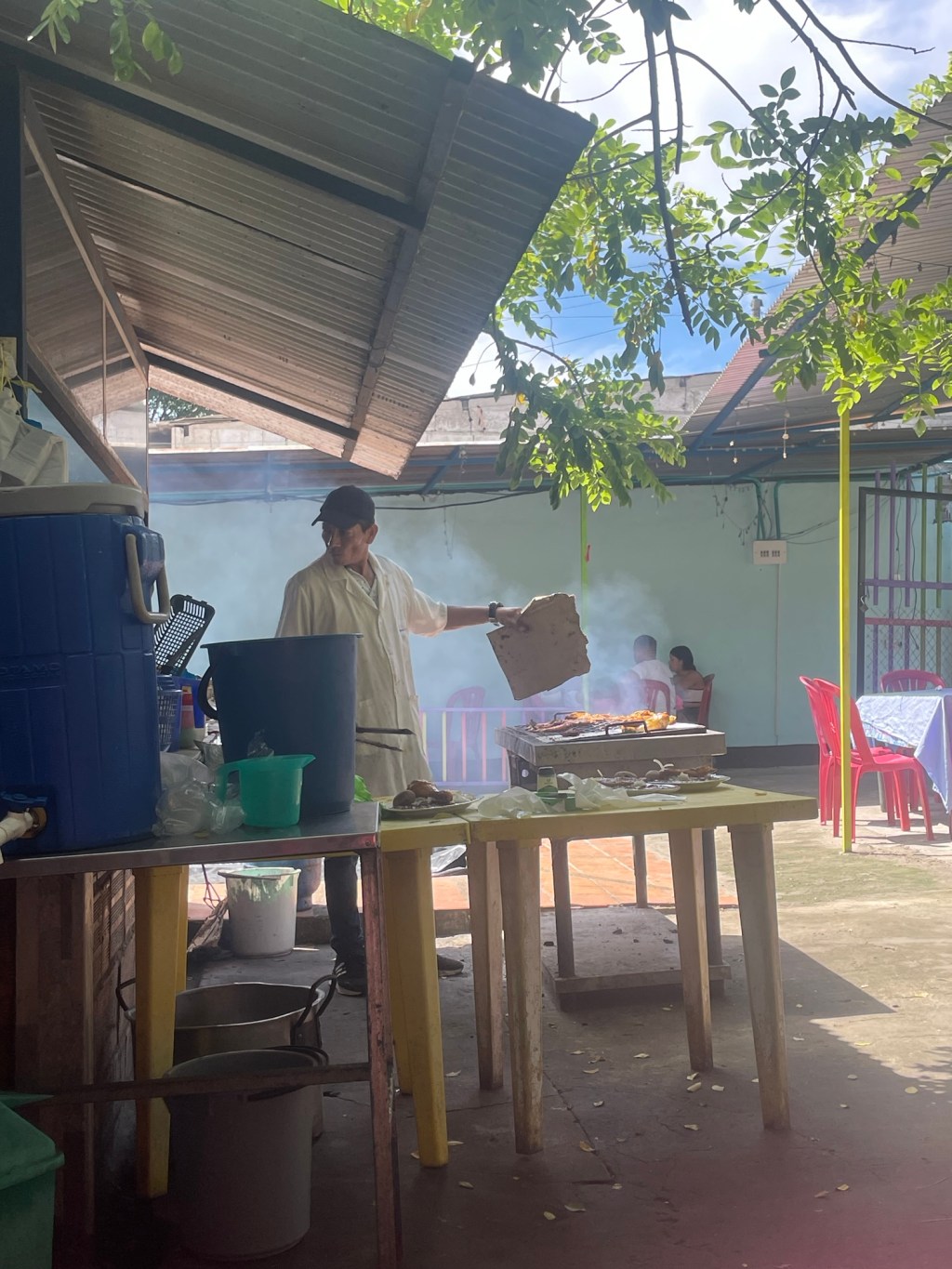
I arrive in Colombia at the start of June. I have planned this trip for years; wanting to stow away somewhere remote, practising Spanish and integrating with a new community.
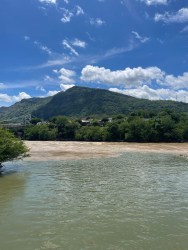
I have been on many solo trips before, but this one feels riskier: less scope for escape should the experience fail. I am house sitting in the town of Honda, a sleepy river haven in the Colombian Andes. Supposedly I will teach English, although the promise of work feels dubious, attached as it is to some shaky Whatsapps exchanged with a man called Jaysonn whose approach to replying is criminally relaxed.
The Honda heat greets like a cushion to the head: disorienting but oddly soft. It’s about 37′ – it will only get hotter during my stay, I am warned.



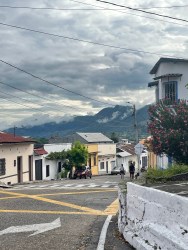

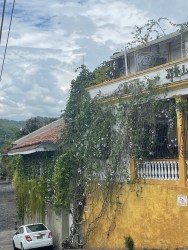

I am welcomed by Pao and her son, Benji. Pao is the Colombian wife of a distant English family friend, Mikey. The family will head to Europe for a month and a half: Mikey kindly responded to my query about volunteering opportunities near him and shared that they were looking for someone to housesit their mosaic-mottled bungalow. Mikey is already in the UK, but Pao and Benji will not fly to Europe for another week, which gives me time to get my bearings before being entirely alone.
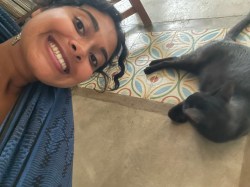
I am greeted with a cocktail of indifference and suspicion by their four cats. They recline around the house, or lumber up to its metal roof where I hear their nocturnal adventures. The family favourite, Mango, is a black and boyish cat with a crooked spine. His disability means that he walks slantedly but with striking assuredness. He is largely house-bound and in need of constant entertainment. Two little toothpick fangs protrude from his slit mouth: I pronounce him my vampire baby, and we engage ferociously in a love-hate dynamic for the duration of my stay.
A Masterclass In Not Really Teaching
The English teaching (which does materialise, although only sporadically and with frequent cancellations) is much less intense than my former English-teaching gigs. I am told that there are already class teachers, and I will be a language assistant supporting with pronunciation and conversation. No planning, no discipline.
I am bemused by the screaming, jostling, and phone use rampant in every classroom. Teachers allow students to translate every exercise on ChatGPT, give them unlimited time to finish tasks, permit them to unabashedly scan TikToks on class time.
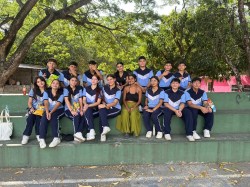
Sometimes teachers leave the classroom halfway through the lesson, informing me that they will return in just a moment: the moment never comes. I am left with a class whose curriculum I am unfamiliar with, not knowing whether to mark their work, start a game, or bid them leave.
The younger children that I work with, aged 5-6, pile atop one another, screaming, and animatedly listing their achievements to the teacher. They hug me hello and write me welcome letters. Considering their unruly classroom decorum, they are exceptional at following complex choreography: they are tasked by their teacher with learning all of the lyrics and Just Dance moves to Barbie Girl. Neither they nor their English teacher understand the lyrics that they solemnly belt: ‘TOUCH ME HERE TOUCH ME THERE HANKY PANKY’.
Something else that I notice is how tactile the teachers are with students. To me, it is quite lovely: it is not uncommon for children to sit on their teachers’ laps, for teachers to stroke their arms or heads in greeting. The affection between teachers and students is so warm – platonic, at times parental – but it would never be permitted to flourish in the UK.
I recount my appreciation of this gentle intimacy to a friend some weeks later, but she rebuts my affection.
‘Debes tener cuidado – en Colombia, todo es muy turbio’. Be careful: in Colombia, everything is very murky.
It prevails that a lot of older students have sexual relations with teachers, particularly queer young men. It can be an open secret, and can take teachers a long time to be held accountable. I lamentedly accept this, but do not let it tarnish the fondness I have for the very sincere relationships that I have witnessed.
There are other volunteers in the school: two English girls and a Dutch boy. They fly home almost as soon as I arrive, so I only overlap with them for a few days. Before their departure we indulge in a night out with some of the locals: the two English girls snog their temporary Colombian boyfriends and grind into their crotches (a la Colombian party moves). I love Reggaeton, but am a stiff dancer and feel awkward because Colombian nights out are essentially meet markets: the discotecha is a box of ribbons masquerading as bodies, enchanted into slippery movement by the flailing of buchacha, salsa, and whatever the technical term is for rhythmic dry humping. I am grateful, in my 3 visits to Colombia, that I never fell in love with a Colombian boy, which would have left me shouldering the burden of trying to keep one particular ribbon out of the ribbon orgy. I laugh and gently decline invitations to dance.
I soon discover why the other volunteers are leaving: Jaysonn informs me that the school is due to go on a 3 week break, just as Pao and Benji are set to leave. Having already committed to house sitting, I fret: how will I spend those three weeks – alone in a town where I do not know anybody, without the means to practice Spanish everyday? The withholding of this information from me until now – despite months of preparatory communication with Jaysonn – is symptomatic of the same haziness applied to the education system and social scene: the type of leneability I term ‘relaxed’ on a good day and ‘neglectful’ on a bad one.
Pao is largely unsympathetic when I come home and relay the information (which she, of course, also knew and withheld).
“Did you not know that it was the holidays?” she asks, somewhat irritably.
Obviously not.
How Will I Spend My Holidays?
Thankfully, Pao is a director at a charming local museum showcasing the history of the Magdalena River: she says that I can help out there for a few weeks during the school holidays. She and Benji depart as the vacations commence, so I arrive at the museum gate on the first day of the holidays. The museum is closed on Mondays, but I am told that Alejandro, a man around my age, will still be there. I wait for three quarters of an hour, shoot him some messages. He does not arrive, no response on Whatsapp. Strangely unphased, I commence the hot, steep walk back up to the house; he motors past me en route, looking sheepish.
“Que pena contigo,” he messages me. How annoying for you.
It is, but I take it in my stride. I begin to unlearn the need for plans. In London, I felt chronically busy but never busy enough, never wanted enough. I compulsively collected experiences without having the time or capacity to relish them. Every hamsterwheel turn – a night out, a new hobby, a new job, a new friend – failed to temper my simmering unease. I realise, in the quiet Colombian sun, that this was perhaps what I sought here: to release the fear of being decentred by a callous city.
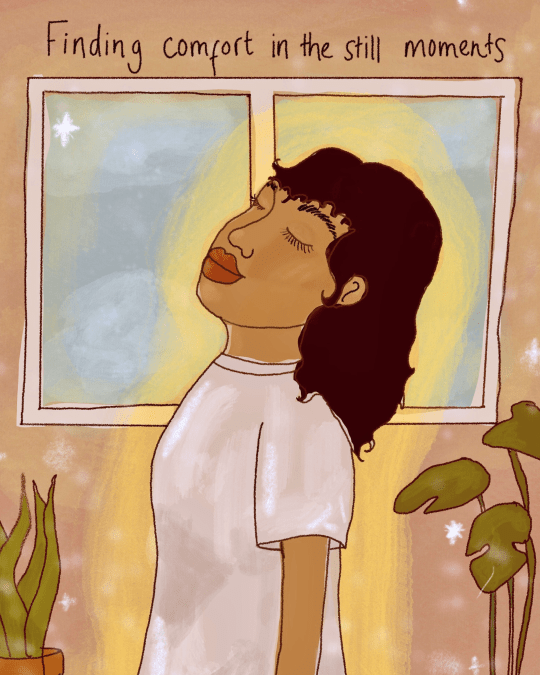
Days float by, leaf-like, the patterns of their landward drift ornate and unaffected. I spend hours sitting alone in the hammock, surprised by my blossoming serenity. I become more quickly entranced by patterns of sunlight on tiles: of veins of water plaiting and carressing and dreaming in a line. One night, when plans fall through, I think, fuck it. I put on my lipstick and my favourite outfit, retrieving my notebook. I find a nice bar, order myself a cerveza, and I write. I write about watching other people be happy. And for the first time, I am content with not being part of their happiness: I feel no rejection, no spite. It is enough to know it is there. Raising my palms to the firelight of others’ friendship, I am warmed by something that does not answer to me.
At night, the sprawl of the house feels warm and unthreatening. It is open plan, open also to the outdoors. I like how the air of the towering mountains is the same air that swathes me in bed. The freshness of it. There is no air con here, despite the heat; just ceiling fans, which do the trick. I nap and cook and prance about, often naked (because I can). The first couple of weeks are punctuated by wild night-time rain showers, which hammer the house’s roof producing deafening static: I wriggle my toes, dopey, and fall back asleep as the rainfall lulls.


At first, the mosquito bites are barbaric. After a while I begin to lie or sit with sheets over exposed skin to deter them.

I become better acquainted with my patterns and reactions, like what incites stress in me, and where in my menstrual cycle I experience severe brain fog. The distractions that I employ in working life like caffeine, excessive socialising and professional progression leave me ignorant to my own mechanics. I know myself better, more delicately, from being away from them. It is a gift.
I spend time in the museum, where there is very little work but ample opportunity for Spanish chatter. I bring my laptop, and spend free time there scribing job applications for my return to Europe. I begin teaching free private English classes for more eager learners: I adore 1-1 teaching, where you can rapidly witness tangible progress in the students’ understanding.
The cats are distraught at the departure of their family hosts. They itch frantically; one of them rubs raw the flesh from her own ear, so myself and the housekeeper take her to the vet. I am convinced it is fleas, a paranoia spurred by my insect bites. Pao insists it is probably stress, and the vet agrees: no fleas.
To reduce their feline anguish, I am urged to stroke and speak with them so that they get used to me. This affection does not come naturally; they sense this as I lean down to tickle them or inquire stiffly as to the quality of their day. To my surprise, after a week or so of this strained effort, their anxious behaviours diffuse and they approach me more readily. There are some calamities – Mango sets about ‘spraying’ in different corners of the house (ew) and when their stress levels are higher they demand more (expensive) food. But overall, we befriend one another: so goes my short spree of cat motherhood.






The Final Honda Spree
My boyfriend Sjoerd arrives around halfway through my time in Honda, nearly a month in: he stays for 3 weeks, until the family returns and I am relieved of housesitting duties. He weaves magic creations from scant veggie supplies and some crumbled campesino cheese: in return I do the washing up.

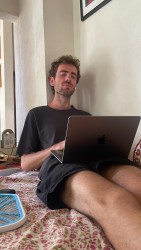
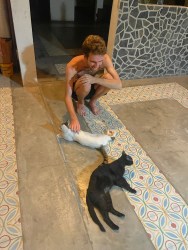
He and I initially meet up in Medellin, which is a 5 hour bus journey from Honda. This feels appropriate, since Medellin is the city where we first met nearly 4 years ago. All that time ago we were rambling about South America in search, probably, of each other. Back then, our Medellin stay revolved primarily around drinking and sampling the city’s many clubs. This time, we opt for a gentler AirBnB in a different part of town. It has a rooftop overlooking the spattering of white buildings that blister up the valleyside, and a motley crew of meth addicts dazedly prowling the surrounding streets.
Once we return to Honda, the weeks are generally filled with a delicious load of nothing. I volunteer again when school resumes, and continue to teach private classes. The heat intensifies as we edge further into July, cusping 40*; the heat quells any desire to do all that much during the day, so we lounge in the hammock, make Spanish vocab lists, and watch films on the projector. On braver days, we swim in the clear waters of the local river, monkey-spot in the nearby forest, and indulge in a weekend-break in nearby Manizales. Once the heat ebbs, we walk around the town, passing pot-bellied neighbours sat outside their houses, cerveza-clad, reggaeton blaring; elderly residents play boardgames on their terraces.
Just as Sjoerd is about to set off and the family are due to return, I decide to leave Honda a couple of weeks early, choosing to spend the last 2 weeks of my 9 week stay in a new remote location: Pacho, a town 90 minutes drive from Bogota. This is partly because I want to turbo-charge my Spanish before returning home. But it is also because the social scene in Honda drives me to despair.
In Colombia, plans made in advance are, I realise, not real. (Sjoerd, who is Dutch, describes a similar pattern of inauthenticity amongst English people, whom he says throw out the phrase ‘that’s interesting’ to signal that their conversational partner is in fact being boring. What we mean is, that is not interesting. Make it stop.)
For example, a Colombian friend might excitedly brainstorm plans for the next day:
‘Hey! I want to show you this club tomorrow, let’s go!’
‘You have to see this village an hour away – I’ll arrange a taxi for us to go this weekend!’
‘I would love to have an English class with you! Can we do it this Thursday?’
The creativity that goes into these entirely false suggestions is compelling. I am reminded of maniacal salesmen trying to shift dodgy stock: deal of a lifetime, not to be missed, you’re robbing me blind!
The plans almost never materialise. The once enthusiastic plan-proposer will not even bother to cancel. They assume that everyone, even newbies, know the deceitful rules of the game.
For the three weeks that I spend living totally alone when Sjoerd has not yet arrived, I participate somewhat in this wicked game because I depend on these unreliable characters to embed myself into the community. The positive side of it is the above: the time I spend becoming better acquainted with myself, and cultivating flexibility in social planning. Amidst this social tyranny, I meet some wonderful, thoughtful, mischievous folk and become a recognised-enough member of the community to be invited to social events that do happen (although Colombian ruling dictates that said plans must take place 90 minutes late). But once Sjoerd arrives, I am much less inclined to engage with social plan-making, since I have learned that it is often a farce.

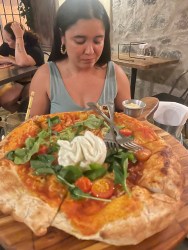


I have relished becoming a part of the educational ecosystem, meeting people for drinks or dinner, children’s cries of ‘Profe! Profe!’ as I walk down the street or buy groceries, seeing a student’s beam as some language rule finally is demisted for them. But there is a toll to the constant self-advocacy necessary to make anything happen here. I have learned so much from the process: I will forever carry gratitude for it. I can happily depart now that the high from this challenge has dissipated into exhaustion.
Pacho
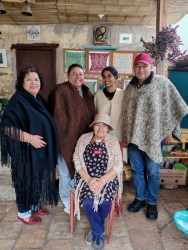
When I arrive in Pacho, a smiling woman collects me from the bus station. Her warmth is instantly relieving, balm pressed tenderly to the wounds of my fatigue. Her name is Amalia, and her love over the next couple of weeks will change me in some small but meaningful way. Living in Honda, I had not detected the tension I had been holding as a result of navigating the rules governing the town without the anchor of a host.
Amalia takes me on day trips with her friends, brings me eagerly to family meals, and we spend evenings cooking and chatting together.
The first day of my new teaching work, there is (of course) no school: it’s a national relaxation day! In Colombia, these occasions are unremarkable because they seem to take place fortnightly. I try to glean the backstory for these festivos, but they seem largely inspired by a mutual aversion to working. I will only be in Pacho for 10 total teaching days, and three of them will be allocated to ‘relaxation’ – so schools will be closed.
The schools are rural and small: one of them consists of just 9 pupils, all of different ages but in one class. Here, young people take care of one another. I never have to hush, or hide from a phone that is being used to snap a BeReal of me, or navigate the teachers’ erraticism as was the case in Honda. Spending time with such kind, inquisitive souls feels almost medicinal.
Everything is planned, respectful. In return for my work I have a room, private bathroom, and full board.
On my first day of school, myself and two of the children pick oranges from the tree that lazes in the school’s courtyard. Throughout the day I am fed freshly pressed juice by the school’s caretaker (one of two staff members, the other being their teacher). This is a welcome, healthy contrast to the excessive dairy that I am persistently – albeit lovingly – spoonfed here (half a packet of brie for breakfast, a cream pie for lunch, arepa filled with a suspicious goo generously titled ‘cheese’ for dinner).
One day a week I attend a different school, which cosies between mountains. The trees are so ethereal that I feel the familiar ache that permeates my nose when tears mount. The greenery is otherworldly, occasionally dusted with orange and purple blossoms, branches swaying like anemones in soft currents.
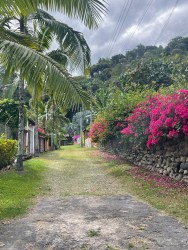
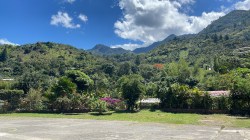
When I leave Pacho for Bogota, there are tears in Amalia’s eyes as she bids me farewell. ‘Cuando regresas en Colombia, ya tienes familia aqui con nosotros. Siempre puedes quedar conmigo.’
This final weekend, I begin to twitch with the need to go home. I knew it would come. It always happens just before I am due to leave somewhere. The last week is like clock-watching. It isn’t that the experience hasn’t been extraordinary. It is merely the awareness of a brewing transition: the need to consecrate the change overpowers.
Fortunately, this gives me time to ponder all that I have learned on this trip. I decide that my largest lesson is never to neglect a dream in the hope that others become emotionally or practically available. London for me represented a near permanent wait, which I realised after a couple of years had no notable climax. The decision to leave it felt like the only possible honest vindication from this deceptively mundane pursuit.
A question for you, reader – would you act or prioritise differently if you stopped waiting for it to have all been worth it?
One day, this relationship will be better. One day this friend will realise they value me. One day I will be promoted. One day this city will give back to me all that it has taken, ten-fold.
Perhaps so – who’s to say? What if we remain enslaved to the eternal allure of the possible, missing what could have been realised were we to abandon the threads tethering us to some frail hope? Even if we do not achieve our goal, perhaps changing direction according to our own navigation will reveal to us some other lesson that shifts our perspective: from experience, I can vouch that it probably will.
This is why I left London (to travel and to move to Barcelona, where I am now scribing this blog from). London was a place that would eternally taunt me with the possible. Perhaps life is a perpetual chase, but I would like the dignity of at least deciding upon the direction of the sprint myself.
I wanted to learn how to be with myself, without distraction: Honda taught me this. I wanted to improve my Spanish: I was thrilled to teach entire classes and hold hours-long conversations by the time I left. I wanted to acquaint myself with other cultures and perspectives: living the village life in Colombia has delivered.
I raise a virtual toast to the joy and importance of pushing on. Of relinquishing anxious shackles to situations that are fractured and unhelpful. Of, where needed, being true to riskier paths.
And, of course, to the beautiful folk of Colombia: thank you for everything you have taught me, chaos and all. Hasta la proxima.

 a-step-aside.com
Leave a comment